
Deckard Is Human
And Blade Runner Is a Better Film Because of It

There is a received wisdom surrounding Blade Runner that has become almost impossible to escape. The 1982 theatrical version was compromised. The studio forced Harrison Ford to record a voiceover he hated. It added a happier ending. Ridley Scott was prevented from making the film he really wanted to make. Then, ten years later, the Director’s Cut appeared, removed the offending narration, restored the unicorn dream and finally allowed us to understand the film properly.
Deckard was a replicant.
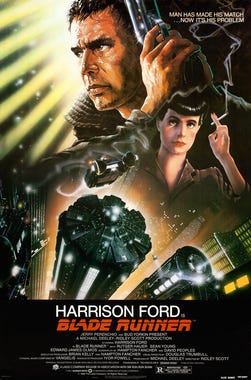
The Final Cut reinforced the point, Ridley Scott has repeatedly confirmed it, and over the years the idea has hardened from an interpretation into something approaching accepted fact. There is only one problem. It makes Blade Runner a worse film.
Not merely because I prefer Deckard to be human. Not because I grew up with the theatrical version and dislike seeing an old film changed. And certainly not because I object to ambiguity.
It makes the film worse because Deckard being a replicant damages the central theme of Blade Runner, creates serious problems with the plot, and requires the viewer to invent an enormous amount of information that the film itself never supplies.
Worse still, the idea that the later cuts somehow transformed Blade Runner into a masterpiece rewrites the history of the film itself. Blade Runner had already become a classic before the Director’s Cut existed.
The supposedly inferior version became the classic
When Blade Runner opened in 1982, it was not the success Warner Bros. hoped for. Reviews were mixed and the box office was disappointing. Then something happened. People kept watching it. They watched it on video. They saw it on television and at repertory screenings. They talked about it. They reconsidered it. Its production design became enormously influential. Its mixture of science fiction and film noir became one of the defining visual languages of modern science fiction. By the end of the 1980s, Blade Runner was already a cult classic. And the version people had been watching was the theatrical version. The one with the voice over. The one that supposedly did not understand the film.
The Director’s Cut did not arrive until 1992. It did not rescue a forgotten bad movie and transform it into a masterpiece. The reputation already existed. Indeed, that reputation was one of the reasons there was enough interest to revisit the film in the first place.
This does not mean everyone loved the voiceover. There were objections to it from the beginning, including from Ford and Scott themselves. But there is an enormous difference between saying the narration is imperfect and claiming that the theatrical film somehow failed until it was removed. The supposedly damaged version was the version that became a classic.
Personally, I like the narration. Blade Runner is noir. Deckard is a detective moving through a rain-soaked city, interviewing witnesses, examining photographs, following leads and hunting killers. A tired, cynical voiceover fits that world.
Ford famously sounds bored while delivering it. Good. Deckard is bored. Deckard is tired. Deckard is emotionally dead. That is rather important.
The human who behaves like a machine
The central irony of Blade Runner is not particularly difficult to identify. The humans behave inhumanly. The machines behave like humans.
Roy Batty wants desperately to live. Leon treasures photographs. Rachael is devastated when she learns that the memories she regards as the foundation of her identity belong to somebody else. Pris and Roy form genuine attachments. Roy grieves when Pris dies. They fear death because they value life.
Deckard, meanwhile, shuffles through the movie like a corpse who has not yet received the information. He drinks. He works. He kills. He lives alone. He has withdrawn from the world to such an extent that Bryant has to threaten him into returning to his old job. And this is the human being.
That distinction matters because of what happens on the rooftop. Roy has Deckard beaten. Physically, the contest is ridiculous. Deckard cannot compete with him. Roy could allow him to fall to his death and would have every reason to do so. Deckard has hunted his companions and killed them. Instead, Roy saves him. The manufactured creature demonstrates mercy to the human who has spent the film treating manufactured creatures as disposable objects. Then Roy dies.
“More human than human” is no longer merely the Tyrell Corporation’s advertising slogan. The replicant has proved himself more humane than the human being sent to kill him.
Now make Deckard a replicant. The scene still means something, certainly. One artificial person has demonstrated humanity to another artificial person who does not know what he is. But something important has been lost. The contrast is gone. Ridley Scott has taken a philosophical idea and turned it into an identity twist.
Instead of asking:
What does it mean to be human if the artificial creature behaves more humanely than the human being?
we are asked:
Did you realise Deckard was one of them too?
I find the first question considerably more interesting.
Fine. Deckard is a replicant. Now make the story work.
The thematic objection would be enough for me. The plot objection is worse. Let us accept Ridley Scott’s interpretation completely. Deckard is a replicant.
Scott has subsequently suggested that Deckard can be thought of as a later model, effectively a Nexus-7, and that Gaff’s unicorn proves he knows the contents of Deckard’s implanted memories. Fine. Now explain Deckard.
The Nexus-6 replicants in the film were manufactured only a few years before the story takes place. Roy is approaching the end of his four-year lifespan. If Deckard belongs to a subsequent generation, he cannot possess the decades of genuine human history his appearance and personality suggest. So what exactly is his history?
Bryant knows him. Not from a file. Not as a stranger who has recently joined the department. He knows him as an experienced former Blade Runner. Deckard has quit. Bryant wants the old Blade Runner back because Holden is not good enough.
Gaff knows Deckard and knows his reputation.
Deckard knows the department.
Everybody behaves as though this man has an established professional history.
If Deckard has only existed for a few years, how much of that history is real? Perhaps he genuinely worked for the LAPD during those years. Fine.
But then why does he believe he possesses a much longer life? Perhaps those memories were implanted. Fine.
But now Bryant and Gaff need somehow to corroborate events that never occurred. Perhaps they know he is a replicant. Fine. Now we have an institutional conspiracy.
The LAPD, an organisation that employs Blade Runners to hunt illegal replicants and whose officers casually use “skin-job” as a slur, is secretly employing a replicant as a Blade Runner while carefully pretending that he is human.
Who knows? Bryant presumably must. Gaff certainly does if the unicorn means what Scott says it means. Who else?
Who manufactured Deckard?
Who created his police records?
Who gave Gaff access to the contents of his implanted memories?
Why does Bryant never behave as though Deckard is a replicant?
Why does nobody call Deckard a skin-job?
Why does nobody treat him differently?
It is possible to answer all these questions. That is not the same as the film answering them.
The headcanon problem
This is where defenders of replicant Deckard begin writing another movie.
Perhaps Bryant is in on it.
Perhaps Deckard is a secret prototype.
Perhaps Tyrell arranged everything.
Perhaps his police records were manufactured.
Perhaps his colleagues were told to pretend they had known him longer.
Perhaps there was once a human Deckard whose history was copied.
Perhaps Nexus-7 replicants were deliberately given normal human strength.
Perhaps only Gaff knows.
Perhaps everyone knows.
Perhaps nobody knows.
Perhaps. Perhaps. Perhaps.
At some point, interpretation becomes headcanon.
You can make almost any plot twist work if you are allowed to invent an unlimited amount of unseen machinery around it. The important question is not whether somebody can devise an explanation. The question is whether the movie gives us that explanation. It does not.
And all this complication exists because of one unicorn.
Why is Deckard so weak?
There is another problem. Every Nexus-6 replicant Deckard physically confronts is stronger than him. Leon beats the living shit out of him. Pris, supposedly a basic pleasure model, is capable of overpowering him. Roy exists on an entirely different physical level. He can make jumps Deckard cannot make, withstand punishment Deckard cannot withstand, and finally pull Deckard to safety when Deckard cannot save himself.
Rachael never demonstrates equivalent strength, but neither does the film establish that she is weaker. Deckard being physically forceful with her tells us nothing about what she would be capable of doing if she chose to resist him.
Now we are told Deckard is a later, more advanced replicant. Apparently Tyrell has deliberately created a replicant with roughly human physical abilities. Possible. But where does the movie tell us that? And why would anybody manufacture a physically inferior replicant and then give him the job of hunting replicants capable of throwing him through walls?
Again, an explanation can be invented. Perhaps his specialised ability is detection rather than combat. Perhaps making him physically ordinary helps him pass as human. Perhaps his reduced strength is part of the experiment. Fine.
The viewer is once again writing missing scenes. Human Deckard requires no explanation. He is weaker because he is human.
Then what the hell is Rachael?
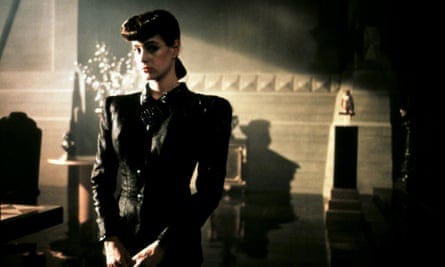
This may be the biggest problem of all. Tyrell introduces Rachael as an experiment. She is extraordinary because she has been given implanted memories and does not know she is a replicant.
Deckard normally needs perhaps twenty or thirty questions to identify a replicant. Rachael takes more than a hundred. Tyrell is enormously pleased with himself. He has created something new.
Except if Deckard is a replicant, he has apparently already created something considerably better. Deckard does not merely believe he is human. He lives independently. He has a career. He has colleagues. He has a professional reputation. He has memories of an adult life. He has worked as a Blade Runner. He has quit being a Blade Runner. He has successfully operated in human society without apparently ever questioning his identity.
Rachael lives under Tyrell’s protection and begins questioning her identity almost immediately after Deckard examines her. Deckard has apparently been wandering around Los Angeles without the faintest idea.
So why is Tyrell showing Deckard Rachael as his remarkable experiment? The remarkable experiment is standing in front of him. If Deckard is a replicant, Rachael’s dramatic function in this part of the story becomes weaker. Tyrell has already solved the problem she is supposedly designed to solve.
Once again, we can invent an explanation. Deckard belongs to another programme. He was made by somebody else. Tyrell is lying. He is an earlier experiment. He is a later experiment.
It does not matter. None of that is in the movie.
Gaff and the bloody unicorn
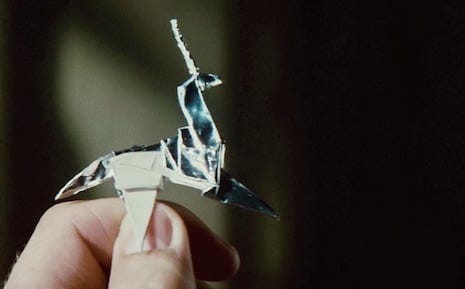
Without Deckard’s unicorn dream, Gaff’s final origami unicorn is a wonderfully strange little gesture. Gaff has been making origami figures throughout the film. He has been inside Deckard’s apartment. He found Rachel. He chose not to kill her.
The unicorn tells Deckard that Gaff has been there and knows what is happening.
Then Scott inserts the dream. Now the unicorn becomes a decoder ring. Deckard dreamed about a unicorn. Gaff makes a unicorn. Therefore Gaff knows Deckard’s dream. Therefore Deckard’s memories have been implanted. Therefore Deckard is a replicant. Gotcha.
Except now we have another problem. If Gaff knows the contents of Deckard’s implanted memories, why?
Scott has subsequently explained the idea as Gaff effectively having read Deckard’s file. So there is a file. Deckard’s artificial identity is documented. Gaff knows. Presumably other senior police officers know. And then Gaff deliberately leaves Deckard a clue telling him that his memories are artificial. Why?
If the purpose of Deckard’s programming is to make him believe he is human, Gaff has just potentially compromised the entire experiment.
Why would he do that?
Once again, the film has no answer because the film was not constructed around answering the question. The unicorn creates the mystery and then pretends that solving the mystery is profundity. I would call it something simpler. A gimmick.
The idea existed, but that is not the same as the finished film supporting it

There is an important qualification here. It would be too simple to say that nobody involved in writing Blade Runner ever considered the possibility that Deckard might be a replicant and that Ridley Scott suddenly invented the idea years later. The screenplay went through numerous drafts, and some unused material did play with Deckard’s identity.
Hampton Fancher did not originally conceive Deckard as a replicant. But during the development of the screenplay he experimented with leaving a suggestion at the end that might cause the audience to question what Deckard was. That material did not become part of the finished 1982 film.
David Webb Peoples also wrote material drawing a much closer connection between Deckard and Roy Batty, including language about them being brothers and being created or programmed. Peoples’ original conception of that idea, however, was philosophical rather than simply a literal revelation that Deckard had rolled off the same kind of production line. Humans are created too. Humans have makers. Humans are shaped by their environment and experiences. Humans possess limited lifespans.
Deckard comes to recognise that the enormous distinction he has drawn between himself and Roy may not matter as much as he believed.
Ridley Scott took that idea in a much more literal direction.
So, yes, the possibility of replicant Deckard existed during the development of Blade Runner. That matters. But something else matters more.
It is not the story presented by the 1982 theatrical film. The unused screenplay suggestions remained unused. Most importantly, Deckard’s unicorn dream was absent.
Scott has subsequently made clear that he regarded the unicorn as fundamental to his intention. Deckard dreams of a unicorn; Gaff later leaves an origami unicorn; therefore Gaff knows something inside Deckard’s supposedly private mind. But the dream was not in the 1982 theatrical release. That is not an insignificant omission. Without it, Gaff’s origami unicorn does not demonstrate that he knows Deckard’s memories. It can simply mean that Gaff was at the apartment, found Rachael, chose not to kill her and left his usual calling card.
The crucial piece of evidence required to transform the unicorn into a replicant clue does not exist in the version audiences actually watched and turned into a classic.
The production history should therefore not be used backwards.
The argument is not:
Ridley Scott invented replicant Deckard in 1992.
He did not.
The argument is:
The film released in 1982 did not contain the material necessary to make Scott’s preferred interpretation function as the story.
And that version became a classic anyway.
Indeed, I would argue that the resulting film possesses a cleaner thematic structure than the one Scott was attempting to impose upon it.
Sometimes an abandoned idea is abandoned for a reason. Sometimes a film becomes better than one of its creator’s intentions. And sometimes putting the idea back in does not restore the masterpiece. It damages it.
“But it’s supposed to be ambiguous”
This is probably the most common defence of replicant Deckard. Perhaps Deckard is human. Perhaps he is a replicant. We are not supposed to know. The ambiguity is the point.
I do not think this solves anything. Ambiguity is not a get-out-of-jail-free card for a story that cannot support one side of its own ambiguity.
A genuinely ambiguous film gives us two or more interpretations that remain coherent when followed through.
Here, the two possibilities are not equal. If Deckard is human, virtually everything in the film works without additional explanation.
He has a history with the LAPD because he worked there. Bryant knows him because Bryant was his superior. Gaff knows him because they were colleagues. Nobody calls him a skin-job because he is human. He is physically weaker than the Nexus-6 replicants because he is human. Rachael is extraordinary because Tyrell has created a replicant who genuinely believes she is human. Roy’s final act matters because an artificial being demonstrates greater humanity than the biological human who has been hunting him. Nothing needs fixing.
Now take the other half of the supposed ambiguity seriously. Deckard might be a replicant.
Immediately the questions begin.
When was he manufactured?
What model is he?
How much of his LAPD career actually happened?
Who created his false history?
Does Bryant know?
Does Gaff know?
If Gaff knows the contents of Deckard’s implanted memories, who gave him access to them?
Why does nobody treat Deckard as a replicant?
Why is Rachael presented as Tyrell’s extraordinary experiment when Deckard is apparently already a much more successful example of a replicant who believes himself human?
Why is this later-generation replicant physically inferior to every Nexus-6 he has to fight?
Why does Gaff deliberately leave Deckard a clue capable of exposing whatever deception has been constructed around him?
None of those questions disappears because we use the word “ambiguous.”
We have simply moved from:
Deckard is a replicant and the plot does not explain how that works
to:
Deckard might be a replicant and the plot does not explain how that would work.
That is not much of an improvement.
The problem is that people often confuse uncertainty with depth. There are genuinely profound ambiguities in Blade Runner.
Are Rachael’s emotions less real because her memories were manufactured?
Does Roy’s capacity for mercy make him human in any meaningful sense?
If memories construct identity, does it matter where those memories originated?
Can an artificial being possess authentic experience?
What does humanity mean once human beings can manufacture something apparently capable of love, terror, grief and compassion?
Those questions do not have answers sitting in a filing cabinet somewhere. Whether Rick Deckard was manufactured by the Tyrell Corporation does.
That is the fundamental difference. Deckard either came out of a replicant manufacturing process or he did not. Somebody made him. He would have an inception date. He would have a model designation. He would have records. If Gaff knows his implanted memories, somebody within the world of the film already knows the answer.
And once Blade Runner 2049 arrives, the attempt to maintain this supposedly profound ambiguity becomes even harder to defend, because the characters themselves have to begin avoiding information they should either possess or be perfectly capable of obtaining.
At that point the ambiguity no longer belongs to the characters. It belongs to the filmmakers.
The characters are being forced to preserve a debate for the audience.
A good ambiguity arises because the truth cannot be known. This one survives because nobody is allowed to ask the bloody obvious question.
Blade Runner 2049 makes the problem worse
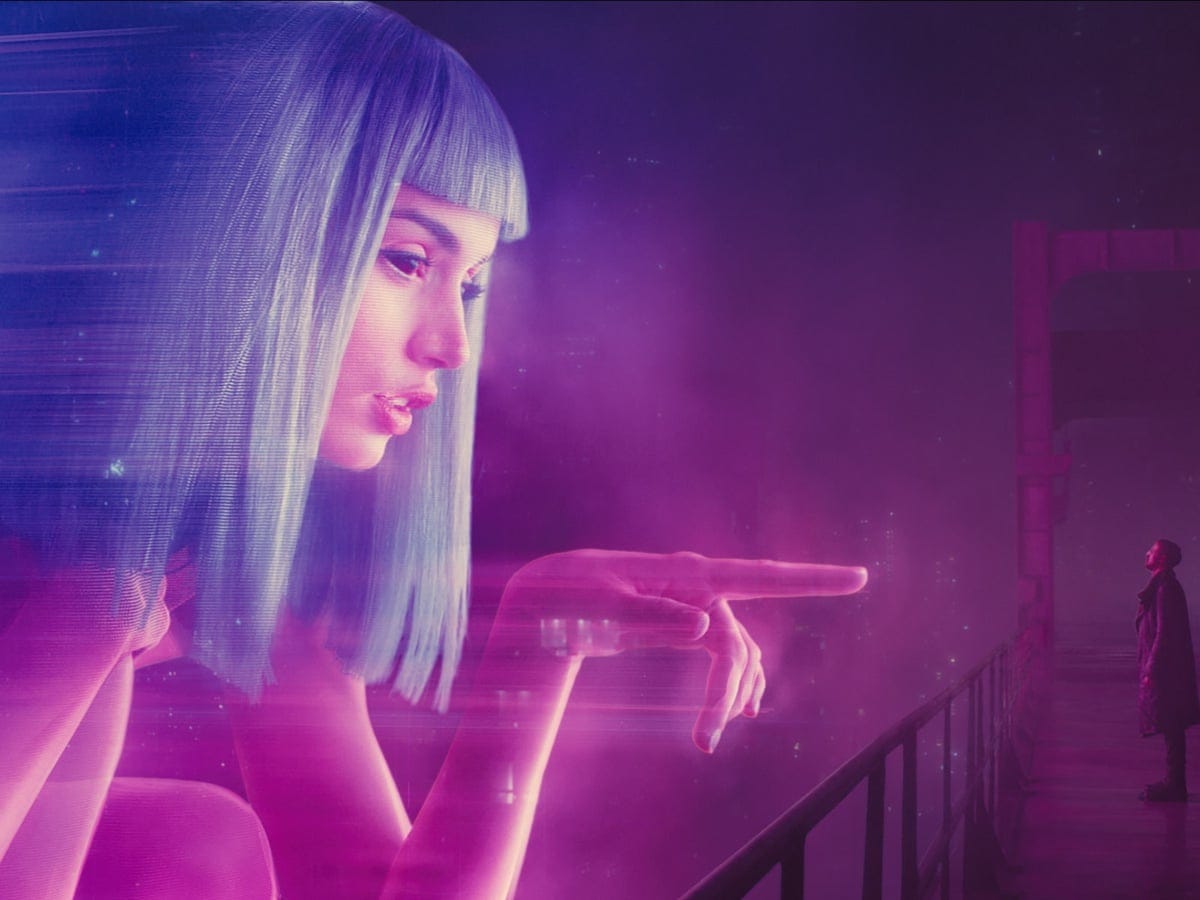
Thirty years later, Gaff is still alive. K finds him. Under Scott’s interpretation, Gaff knows Deckard is a replicant. That is the entire point of the unicorn.
So why does Gaff not simply tell K? Deckard is not present. Tyrell is dead. The original corporation is gone. Three decades have passed. Replicants now openly work for the LAPD. K himself is a replicant Blade Runner.
What exactly is Gaff protecting? More importantly, why should Deckard’s replicant status still be a secret at all?
Somebody manufactured him. He should have an inception date. A model designation. Records. A serial number.
If Deckard was some extraordinary Tyrell experiment, there should be evidence that the experiment happened. Instead the sequel has to dance around the question because answering it would end a debate the filmmakers have decided to preserve.
That becomes even more obvious with Wallace.
Wallace should know, or find out
Wallace’s entire objective is to discover how Rachael reproduced. He obtains Deckard. He wants to break him psychologically. He explicitly raises the possibility that Deckard may have been designed specifically to meet Rachel. Perhaps their attraction was planned. Perhaps Tyrell intended them to come together. Perhaps Deckard’s love was programmed.
If Wallace knows Deckard is a replicant, why the coyness? Tell him.
“You are a machine. Rachael was a machine. Tyrell manufactured both of you. Your memories are artificial. Your relationship was engineered. Your child was an experiment.”
Then show him the records. Then bring out the reconstructed Rachel. That would be a devastating psychological attack because Wallace would not merely be threatening Deckard physically. He would be attempting to destroy Deckard’s belief that anything in his life had ever belonged to him.
Instead Wallace says perhaps. Maybe. What if?
There are only two possibilities.
Either Wallace does not know, in which case Deckard’s supposed identity as a replicant has somehow vanished from the historical record. Or Wallace does know and is refusing to say because the screenplay will not allow him to answer the audience’s question.
Neither is particularly satisfying.
And if Wallace genuinely does not know, there is still Gaff. K can find him. Surely Wallace can. Wallace has Luv murder police officers and anybody else who gets in his way. He is hardly likely to decide that questioning an elderly retired policeman would be an unacceptable invasion of privacy. If Gaff knows what Deckard is, send Luv to Gaff. Ask him.
“Was Rick Deckard a replicant?”
There. Mystery solved.
The reason this never happens is obvious. The characters are not protecting the secret. The screenwriters are protecting the argument. That is not organic ambiguity.
2049 even shows us what a replicant Blade Runner looks like
There is another irony in Blade Runner 2049. It gives us K. K is unquestionably a replicant. And everybody knows it. Other police officers insult him because of it. His superior knows exactly what he is. His behaviour is monitored. He undergoes baseline testing. His identity is institutional rather than secret. His position within the police force is explicitly different from that of the humans around him.
This is what a replicant Blade Runner looks like when the police knowingly employ one. Now compare that with Deckard.
Bryant treats Deckard as an experienced former colleague. Gaff treats Deckard as a fellow officer. Deckard quits his job. Nobody monitors him as a machine. Nobody identifies him by a replicant designation. Nobody calls him a skin-job. Nobody behaves as though his existence is fundamentally different from that of the humans around him.
The sequel, while desperately trying not to answer whether Deckard is a replicant, inadvertently makes human Deckard even easier to believe.
The theatrical cut simply works
Now remove the unicorn dream. Deckard is human. What breaks? Nothing.
Bryant knows Deckard because Deckard worked for him. Gaff knows Deckard because Deckard was a Blade Runner. Nobody calls Deckard a skin-job because Deckard is not one. Deckard is weaker than the Nexus-6 replicants because he is human. Rachael is extraordinary because she genuinely represents something new. Deckard’s professional history is real. No secret LAPD/Tyrell programme is required. No manufactured employment history is required. No mysterious Nexus-7 backstory is required. No explanation is required for why Gaff knows Deckard’s private dreams. And Roy Batty’s final act retains its full power.
The machine saves the man. The supposedly artificial being turns out to understand humanity better than the person sent to destroy him.
That is Blade Runner. At least, it is the Blade Runner audiences discovered in 1982 and turned into a classic long before the Director’s Cut arrived.
Sometimes the director is wrong
There is a tendency to regard a director’s preferred version of a film as automatically definitive. I do not accept that. Films are collaborative. Writers write them. Actors interpret them. Editors shape them. Producers interfere with them. Studios interfere with them. Sometimes that interference damages a film. Sometimes it accidentally improves it.
Ridley Scott unquestionably directed one of the greatest-looking science-fiction films ever made. His visual conception of Blade Runner is extraordinary. That does not mean every idea he had about the story was equally good.
Making Deckard a replicant does not deepen the film. It weakens its central thematic contrast. It undermines Rachael’s uniqueness. It complicates Deckard’s history. It creates unexplained institutional knowledge. It makes Gaff’s behaviour difficult to justify. It requires a physically ordinary later-generation replicant whose purpose is apparently to fight much stronger earlier-generation replicant. And it eventually forces a sequel to have characters spend entire scenes refusing to answer a straightforward factual question because the filmmakers want the audience to continue arguing about it.
All for one revelation:
Deckard was a replicant too.
No thanks. I will take the supposedly inferior 1982 version. The one with the tired voice over. The one people actually turned into a classic. The one where Deckard is human. Because Blade Runner does not need us to wonder whether Deckard is secretly a machine. It already asks the much harder question.
Why does the human behave like one?